
Ham Lake, MN · Garage Door Service
Why a Garage Door Goes Off Track Around Ham Lake
Ham Lake homes built mostly between 1960-2003 face track problems from cold-snap metal contraction and aging rollers. Here's what actually knocks a door off track here.
- Repairs & new doors
- Springs & openers
- Serving 7 nearby communities
How Local Conditions Play In
Most houses in this area went up between 1960 and 2003, with the bulk of the stock dating to the 1980s and 90s. That matters for track problems because the track brackets and jamb hardware installed in that era were fastened with lag screws into framing that's now had 30 to 40 winters to shrink, swell, and shrink again. A bracket that was snug in 1986 can work loose by now, and a loose bracket lets the track flex sideways every time the door runs.
Then there's the cold. This area sits in a severe cold climate band, and a severe cold band doesn't just mean the door feels stiff in January - it means steel track rails contract enough through a hard freeze-thaw cycle to open up gaps at every joint where sections bolt together. A track that was dead straight in August can show a quarter-inch kink in February once that steel pulls tight. Run a door through a kinked track enough times and a roller eventually jumps the rail instead of riding it.
We see this most on doors that haven't had the track bolts checked since they went in. Nobody thinks to recheck hardware that's never failed before - until a cold morning finds the gap that was already there.
When It Stops Being a DIY Job
If a roller has jumped the track but the door is still sitting square in the opening and nothing's bent, you can usually walk it back onto the rail by hand with the opener disconnected - that's a five-minute fix for anyone comfortable popping the release cord.
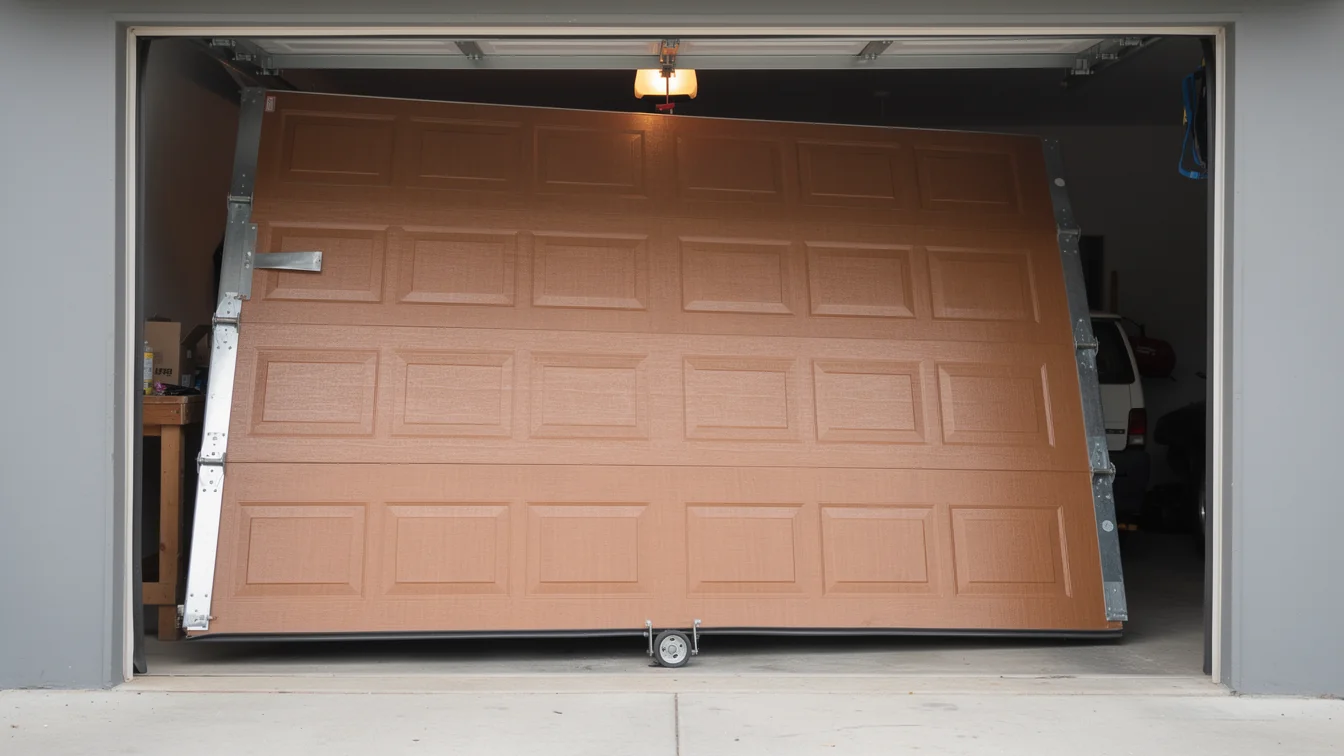
It stops being a DIY job the moment the track itself is bent, not just vacated. A bowed rail from a stuck door forcing itself through a partial jam, or a bracket torn loose from the jamb, means the door is no longer running true even if you muscle the roller back in. Forcing a motorized opener to run a door against a bent track puts load on the opener's gears that they weren't built for, and on a cable drum that can shred a cable under that extra resistance. At that point you're not fixing a track, you're risking a second failure on top of the first.
We'll say plainly: we don't recommend trying to straighten bent track yourself. Track steel work-hardens once it's been bent and re-bent, and a rail that looks straight again often isn't within the tolerance the rollers need. Replacing the section is usually faster and cheaper than the hours it takes to get a hand-straightened rail actually true.
The Situation
With a median household income around $100,011 across the service area, a lot of homeowners here have the option to replace hardware before it becomes a breakdown rather than waiting for a Saturday morning the door won't open at all. That's the right call on track issues specifically, because track failure rarely happens in one dramatic moment - it's a bracket that's been loosening for two winters, or a rail that's been slightly out of plumb since a settling shift in the slab.
Across the 31 named areas we work in, the pattern repeats: 1980s and 90s construction, original track hardware, decades of freeze-thaw cycling on steel that was never rated for anything else but still takes a slow toll. Houses built later in that window, closer to 2003, tend to have slightly better bracket fastening into engineered framing, but even those are 20-plus years in now.
This isn't a scare story - most tracks run fine for decades. But when a door starts binding, rattling at one spot every cycle, or a roller rides visibly high on one side, that's not something that fixes itself with warmer weather.
What to Look At First
Start at the brackets, not the track itself. Walk the full length of both rails with the door closed and check every lag screw by hand - on a house from the 1980s or 90s stock common here, it's common to find one or two backed out a quarter turn, especially near the top bend where the track curves onto the horizontal run.
Next, sight down the vertical rail from the floor. A straight rail reads as one clean line; any visible bow or step at a joint is your answer right there. Check this after a stretch of hard cold if you can, since that's when a marginal gap shows itself most.
Last, listen. A door that's about to jump track usually telegraphs it first - a scrape or a hesitation at the same spot in the cycle, run after run. That's the roller riding the edge of a gap before it finally jumps clear. Catch it there and it's a bracket tightening and a track alignment, nothing more. Miss it and you're looking at a bent rail section and a bigger bill.
One honest limit: we don't do cosmetic track painting or touch-up work - if the rail's structurally fine but rusted or scuffed, that's outside what we take on.
Frequently asked questions
Why does my garage door only go off track in winter?
Steel track contracts in severe cold, and this area sits in a cold band hard enough that joints between track sections can open a visible gap by midwinter. A roller riding near that gap is more likely to jump the rail than it would be on a mild 60-degree day, which is why track problems cluster in the cold months here.
Is a bent track always a replacement, not a repair?
Usually, yes. Once steel track has bent and been bent back, it rarely holds true tolerance for the rollers again. We generally replace the bent section rather than straighten it, since a slightly-off rail will keep causing the same jump-track problem within a season or two.
My house was built in the 1980s - is that relevant to track issues?
Yes. A large share of homes in this area date to that decade, and track brackets from that era were fastened into framing that's had three or four decades of freeze-thaw movement since. Loose brackets are the most common root cause we find behind a door jumping track here.
Can I just push the roller back onto the track myself?
If the track isn't bent and the roller simply popped off a straight rail, yes - disconnect the opener, guide the roller back onto the rail by hand, and check nearby bracket screws while you're there. If the rail itself looks bowed or stepped at a joint, that's a different repair and not a hand fix.
Related garage door services in Ham Lake
More garage door guides
Book garage door service in Ham Lake
Call now or request a quote - tell us what the door is doing and where you are.