
Ham Lake, MN · Garage Door Service
Garage Door Roller Replacement in Ham Lake
Ham Lake homes built mostly between 1960 and 2003 wear out garage door rollers fast in Minnesota's cold winters. See what a roller job involves and costs.
- Repairs & new doors
- Springs & openers
- Serving 7 nearby communities
How Long It Takes
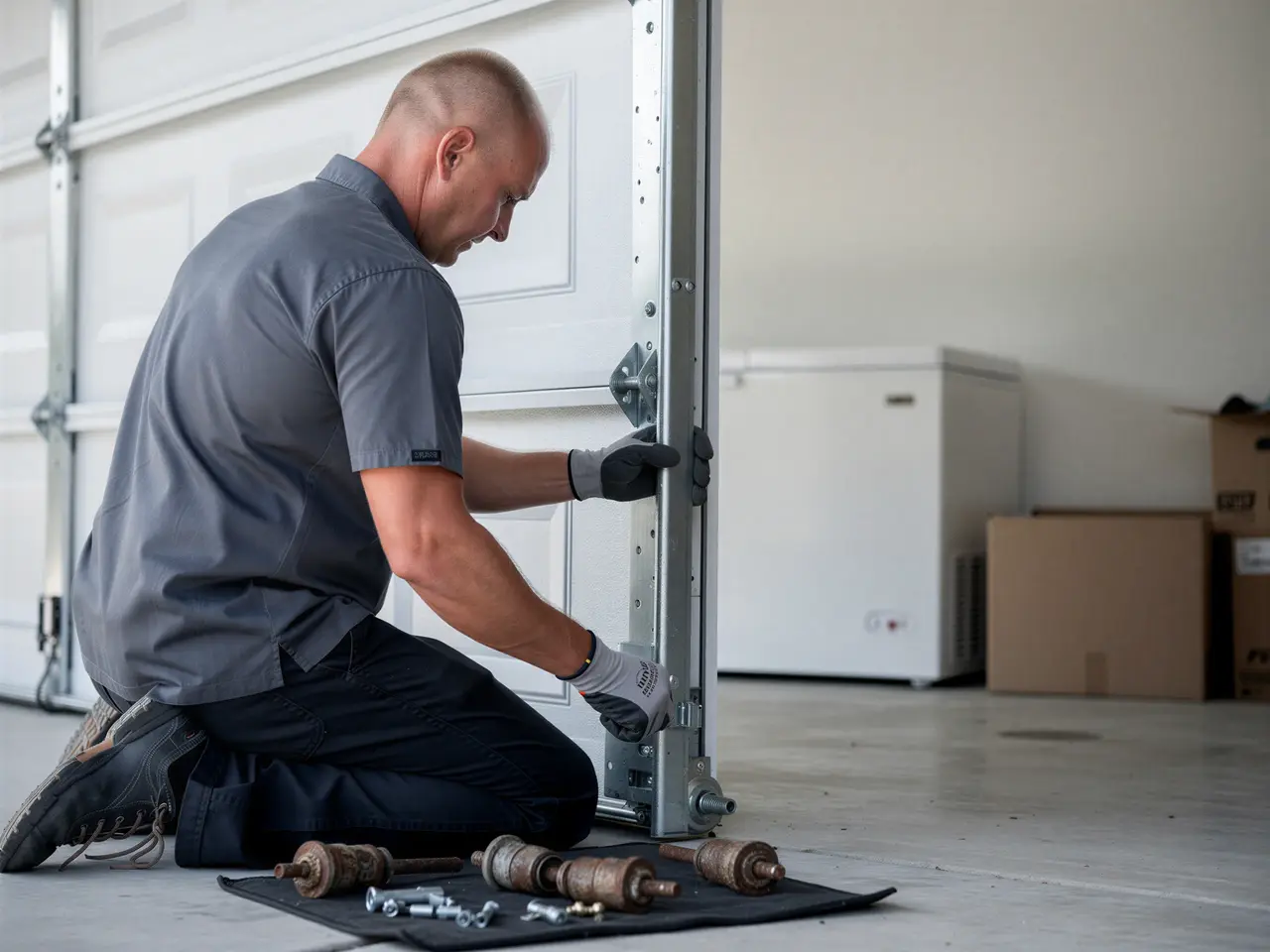
A straight roller swap on one door, both tracks, usually runs under an hour once the truck is parked and the door is up on the jamb. That's pulling the old rollers out of the hinges one at a time, working down the track, and not touching springs or cable. If the track itself is bent or the hinges are stripped from years of a dragging roller grinding metal on metal, the job runs longer because we're straightening or replacing track sections too. Two-car doors with rollers failing on both sides, which is common once one side goes because the door's been riding unevenly, take longer than a single-side job. We won't quote a number here because every door's hardware is different - some have the original builder-grade hinges, some have been upgraded already, and that changes how fast the old rollers come out. What we can tell you is that a roller job is one of the shorter repairs we run, well under what a full spring or opener job takes, because nothing on the door needs to be under tension to do it safely.
The Symptom
It starts as a squeal or a rattle when the door moves, usually worse on cold mornings before anything's had a chance to warm up. As it gets worse, you'll see the door jerk or hang up at the same spot on the track every time - that's a roller that's gone flat-sided or cracked, catching instead of rolling. On older doors you'll sometimes see a roller that's worn down to the steel stem with no wheel left on it at all. This region sits in a COLD-severe climate band, and that matters here specifically: the nylon jacket on a stock roller gets brittle in sustained sub-zero weather, and brittle plastic cracks under load instead of flexing. A roller that would survive another five years in a mild climate splits here in one hard winter. If your door is noisiest on the coldest days and quiets down some once it's been run a few times, that's the nylon telling you it's past its working life, not just a case of needing grease.
The DIY Question
Replacing a roller on a residential door usually means removing the hinge it's seated in, which on most doors isn't a tensioned part - the springs don't touch it. That makes roller replacement one of the more DIY-friendly garage door repairs, with one catch: the bottom roller on each side sits inside a track section that's close to the cable drum and the bottom bracket, and that bracket is under spring tension on a door that's down. Working near it without knowing which bolts are load-bearing is how people lose fingers, not an exaggeration we're making up for effect. We'll also say plainly that if your rollers are original to a door built decades ago, the track gauge and hinge spacing may not match what's sold at a hardware store today, and a mismatched roller will bind worse than the one you pulled out. That's not a scare tactic, it's just a parts-fit problem we see on older housing stock more than new builds. If you're comfortable with a wrench and your door isn't sagging or off-track, the top and middle rollers are a reasonable DIY job. The bottom ones, we'd rather you call.
Why This Fails Locally
Most Ham Lake-area houses went up between 1960 and 2003, with the typical build year sitting around 1984, and across the roughly 31 named communities this crew works the bulk of that housing stock dates to the 1980s and 90s rather than being new construction. That matters for rollers specifically: a steel-stem, nylon-wheel roller has a service life measured in years, not decades, and a door built in the Reagan era is well past its second or third set already, often on the original hinges even if the rollers were swapped once before. Stack that housing age against a COLD-severe climate band and you get a roller that fails faster here than the same part would in a milder region, because the nylon jacket goes brittle in the deep-cold stretches this area gets every winter. With 45,198 owner-occupied houses sitting across 75,618 households in this service area, a lot of those garages are carrying the same era of hardware at roughly the same time, which is why roller calls cluster hard in late fall and midwinter. At a median household income of $100,011, most owners here can afford to put in sealed-bearing steel rollers instead of patching with the same builder-grade nylon that failed the first time - a one-time upgrade that holds up a lot longer in this climate than what the door shipped with.
Frequently asked questions
How do I know it's the rollers and not the opener?
If the door squeals or jerks while moving but the opener motor sounds normal and the door still reaches full open and close, it's almost always the rollers or the track, not the opener. Openers failing tend to show up as the door not moving at all, or reversing mid-cycle. A grinding noise that travels with the door as it moves along the track is a roller problem.
Can I replace just the worst rollers instead of all of them?
You can, but rollers on the same door usually wear at close to the same rate since they've carried the same age and the same winters. Replacing just the worst one or two often means a second call within a year or two when the next ones go. Most owners here find it cheaper in the long run to do the full set at once.
Will new rollers fix a door that's off-track?
Sometimes, if the track came off because a cracked roller slipped out of the channel. But if the door is off-track and the track itself is bent or the cable has jumped the drum, new rollers alone won't put it right. That's a separate repair we'd need to look at before quoting the roller job.
Related services
By Neighborhood
Roller Replacement across the Ham Lake area
We also handle roller replacement in these Ham Lake-area suburbs.
Book garage door service in Ham Lake
Call now or request a quote - tell us what the door is doing and where you are.